
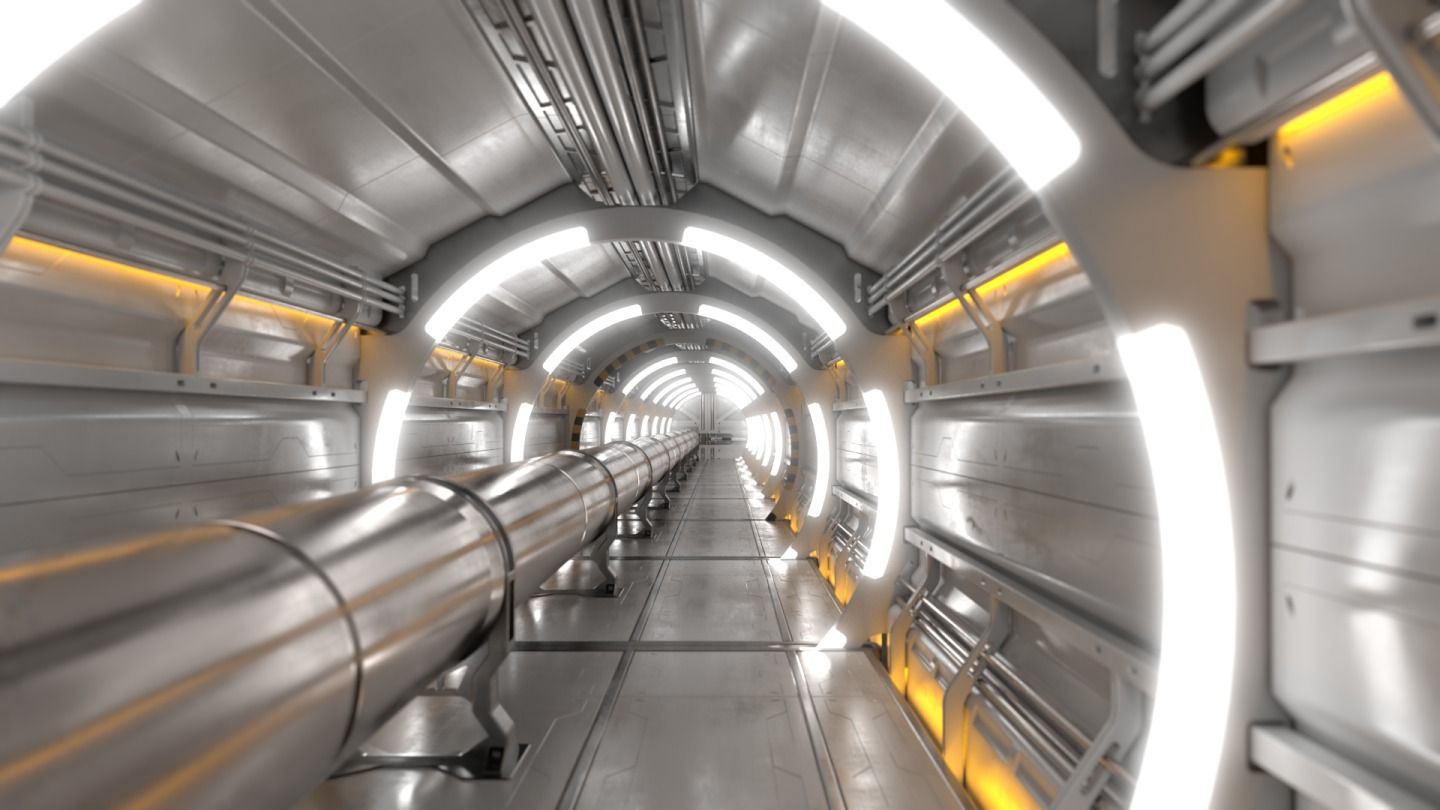
- CERN is pulling the LHC's old NbTi focusing magnets to fit Nb3Sn quadrupoles as part of its High-Luminosity LHC-centric upgrade
- The replacements are the first Nb3Sn magnets ever run in a working accelerator
- The High-Luminosity LHC is scheduled to start up in June 2030, about a year later than originally planned
The Large Hadron Collider has been switched off since late June 2026, and CERN's engineers are now taking it apart.
Since September 7, teams on either side of the ATLAS and CMS experiments have been dismantling the machine to remove 28 superconducting magnets, including the "inner triplets" that squeeze the proton beams just before they collide.
Their replacements are made from niobium-tin (Nb3Sn), a superconductor that keeps working in far stronger magnetic fields than the niobium-titanium (NbTi) the LHC was built with, but, as a trade-off, it is too brittle to bend once it has formed.
A manufacturing challenge meets evolving requirements as CERN looks to the future
The manufacturing, however, is challenging, to say the least, given the brittle nature of the replacement material. Just how awkward that makes the entire process is the subject of a study published September 24 2026 in IEEE Transactions on Applied Superconductivity and written up by IEEE Spectrum on November 10.
Across the program, 250 coils were produced, and 25 failed, either through human error or because the process left them with substandard electrical or mechanical properties. One was scrapped because a single metal particle trapped between the coil and a protective component was suspected of affecting its performance. That 90% yield aligns closely with the 89% the US side reported after its first 110 coils in 2024.
The High-Luminosity LHC (HL-LHC), now scheduled to start in June 2030, is meant to raise the number of proton collisions in each bunch crossing from about 60 today to between 140 and 200. More collisions mean more chances to catch rare events, and a lot more data for a lab that passed an exabyte of storage capacity in 2023 and already runs more than 120,000 hard drives in its central data center.
Getting there depends on focusing the beams harder at the collision points, which is the inner triplets' job. The new quadrupoles have a 150 mm aperture, up from 70 mm in the magnets being removed. The wider bore gives the beam room to swell as it passes through the triplet, which in turn lets the magnets focus it to a smaller spot where the protons meet.
The choice of superconducting material comes with its own challenges, however: NbTi is ductile and can be extruded and drawn like copper wire. Nb3Sn is an intermetallic compound that forms only around 650 °C and is brittle and strain-sensitive once formed. Winding a finished superconductor is therefore off the table, so the coils are made by a process called wind-and-react.
Nb3Sn itself is hardly new; It has been a staple of high-field research magnets for decades and is used in fusion projects such as ITER. What CERN says is new is accelerator-quality Nb3Sn at this length; its 7.2 m quadrupoles are the longest such magnets ever built.
Although the current process is only just getting underway, the stakes extend well past 2030. In May, the CERN Council named the electron-positron Future Circular Collider (FCC-ee) its preferred next flagship, with a decision on whether to build it expected around 2028. An electron-positron ring does not need record-field magnets, but its proposed proton successor, FCC-hh, would. CERN's High Field Magnet program is targeting Nb3Sn dipoles with a 14 T operating field, and current FCC-hh parameter sets call for more than 4,400 dipoles. TechRadar first covered CERN's plans for a ring of that scale in 2019, when the FCC was still a conceptual design.
That makes the HL-LHC's 30 quadrupoles the closest thing anyone has to a production run of Nb3Sn accelerator magnets. A one-in-ten coil rejection rate, two underperforming prototypes, a descoped dipole, and a successful quench-free full-scale test are, taken together, the most concrete evidence yet of what it would take to build thousands more.


